
North Dakota Breeding Waterfowl Survey Reveals Slightly Drier Conditions, Fewer Ducks
Blue-winged teal decline, but mallards and pintails numbers increase over 2025
BISMARCK, NORTH DAKOTA — The number of breeding ducks settling in North Dakota this spring dropped 9.5% from 2025, and the state’s water index showed the landscape was 2.9% drier than last May.
The North Dakota Game and Fish Department’s Breeding Duck Survey conducted across the state on May 11-13, estimated 2.4 million ducks — a decline of more than 250,000 ducks from the 2025 estimate. Notably, the 2026 estimate is 3.4% below North Dakota’s long-term annual breeding duck population estimate that dates back to 1948. It’s also the state’s lowest breeding population since 1994.
Watch 2026 Breeding Duck Survey Webcast
John Palarski, supervisor of migratory game bird management for the NDGFD, pointed out that while North Dakota overall was slightly drier than 2025, the water index is 35% below the survey average from 1948 to 2025.
“Wetland conditions were highly variable across the state during the survey in mid-May, with evident rapid drying occurring just prior to the survey,” Palarski said. “Despite a significant snow event in the beginning of April, rapid drying has occurred which has greatly diminished temporary and seasonal wetlands. A proliferation of wetland drainage has been documented along survey routes, which further reduces the ability of smaller wetlands to hold water.”
North Dakota is the heart of the U.S. prairie pothole region, annually producing millions of ducks that migrate throughout all four flyways.
“North Dakota holds a large percentage of the breeding potential for ducks in the U.S. prairie pothole region,” said Joel Brice, Delta’s chief conservation officer. “The 2026 survey results reflect how dry the prairies have been in recent years. North Dakota is holding steady, but we’re not getting enough precipitation to fully recharge the state’s wetlands.”
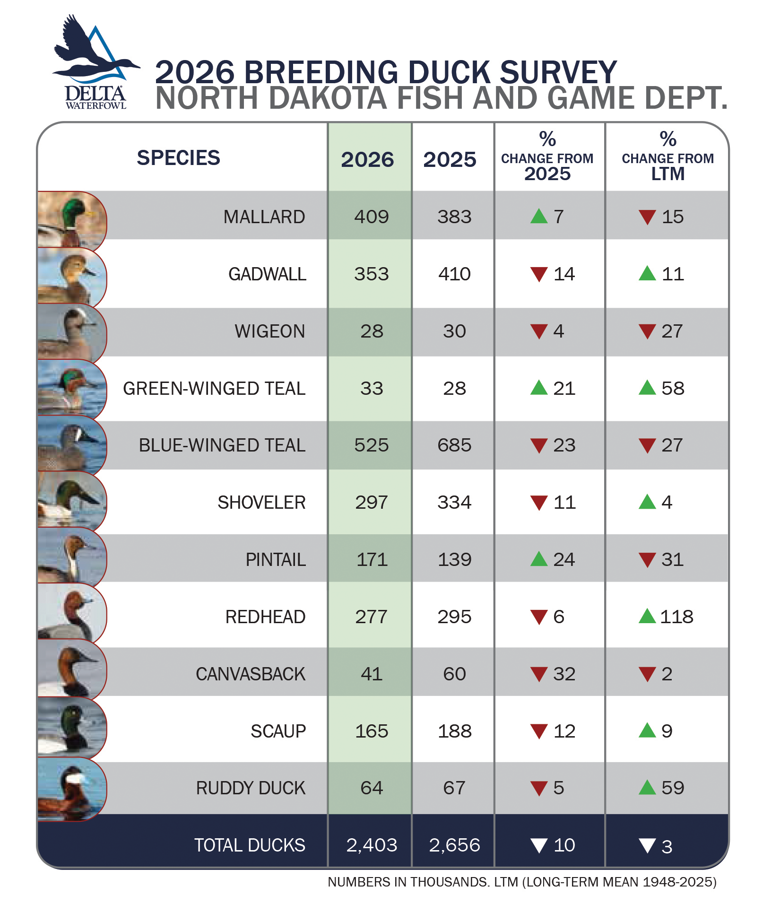
Blue-winged teal, North Dakota’s most common nesting duck, were estimated at 525,163, a 23.4% decrease from 2025, and 26.7% below the long-term average.
The survey estimates 408,893 mallards, a 6.9% increase over last spring, but still 15.3% below the long-term average and the second-lowest total since 1993. Pintails are a similar story, increasing 23.7% from 2025 to 171,371, but still 30.7% below average.
Among other puddle ducks surveyed, gadwalls dropped 13.8% to 353,326, shovelers declined by 11% to 297,136, and wigeon fell 4.2% to 28,328. Green-winged teal increased 20.9% to 33,309.
Diving duck numbers were down across all reported species, with a total estimate of 546,963, a 10.4% decline from 2025. Canvasbacks decreased 31.8%, redheads were down 6.3%, scaup were 12.3% lower, and ruddy ducks dipped 4.6%.
The survey estimates 199,232 Canada geese, a 6.5% decline from 2025, but still more than double the state’s population management objective.
“We are still waiting to see what brood water conditions will be throughout the state,” Palarski said. “More precipitation will be needed to have ample brood habitat. The July brood survey will give us a better idea of duck production, and better insight into what to expect this fall.”
Delta Waterfowl is The Duck Hunters Organization, a leading conservation group founded in 1911 that uses science-based solutions to produce ducks, conserve prairie wetlands, and ensure the future of waterfowl hunting in North America. Visit our website.
For more information, contact Joel Brice at jbrice@deltawaterfowl.org.