
Big Passion for Big Bores Coming to Delta Expo
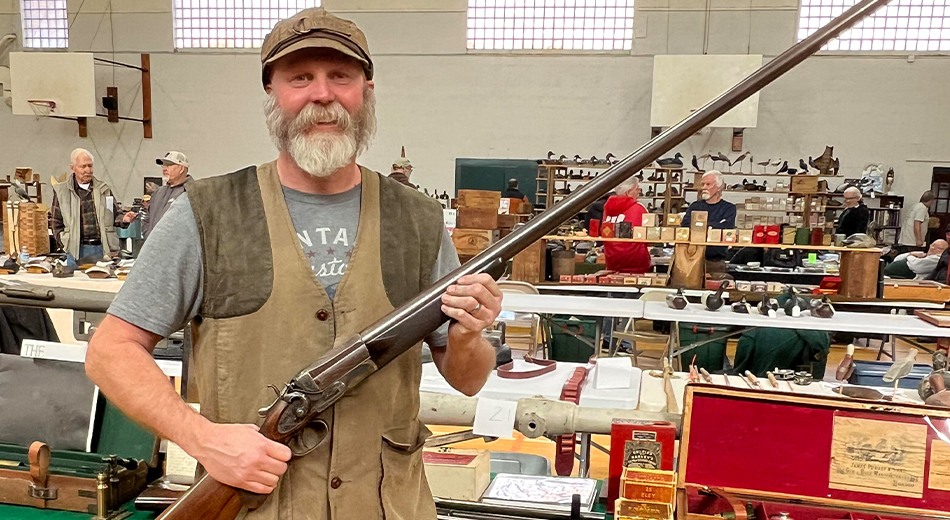
Talk with high school teacher Marty Sands for a few minutes, and you’ll know right away that he’s a man of great passion.
The list of subjects he teaches is long: small engines; motorcycles; automotive I, II, and III; CDL truck driving; off-road equipment and diesel mechanics; and welding. He’s mighty proud of his students and the career paths they have chosen.
Sands has an equal enthusiasm for duck hunting. He remembers great hunts with his brother from childhood during a brief move from Wisconsin to Arizona in the 1980s.
“The duck hunting in Arizona was crazy, like you’d never think of!” Sands said. “We’d hunt these little stock ponds for canvasbacks, cinnamon teal, goldeneyes, bluebills, everything you could imagine, all in the same spot. We started out using .410s back then, hunting ducks in the morning; Gambel’s quail and doves in the afternoon.”
When he was 12, Sands hunted from a blind on a hilltop overlooking Horicon Marsh in eastern Wisconsin. He had a 12-gauge that morning, but the geese were flying high. His father always hunted Canadas with a 10-gauge. After his dad pass shot a high-flying goose, Sands begged to use the 10.
After a few misses and some coaching, Sands brought down a honker that sailed before crashing into the ground. He sprinted out to retrieve his first goose. As he hiked back carrying the big bird, hunters in other blinds across the field cheered and clapped. From that day on, Sands was hooked on big-bore shotguns.
The First East Coast 4-Bore
His passion has grown into a large and ever-expanding collection of vintage waterfowling gear — punt guns, 8-, 6-, and 4-bore shotguns, and much more. If you’re headed to the Delta Duck Hunters Expo July 24-26, in Des Moines, Iowa, Sands will be there, exhibiting a large portion of his collection and sharing his passion with attendees.
On display will be a 4-bore English-made W.W. Greener breech-loading shotgun, which was sold new in 1882 in New York. The 18-pound “Treble Wedge Fast” model is a single-barreled, top-lever, hammer gun, with a 45 ½-inch Damascus barrel. It has an extra full fixed choke with a constriction of .120. Sands and the gun’s owner, Tom Armbrust, believe it was probably the first big-bore gun used on the East Coast. They’ve also traced its history through Alaska, where it was likely used by native peoples for subsistence hunting well into the 20th century.
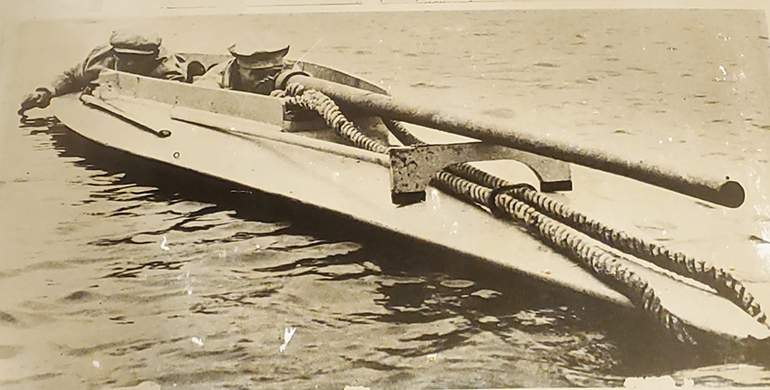
Sands also collects punt guns, like this one, which were used by market gunners prior to the passage of the Migratory Bird Act of 1918.
“It’s interesting that around the turn of the century, Greener changed the model name to the Farkiller,” Sands said. “That’s what these big-bore guns were for, reaching birds at longer ranges for wealthy shooters of the day. Guns of this quality were not within reach of the average hunter.”
Documentation shows that this Greener was originally a “35 to 40 guinea gun,” meaning it cost 35 to 40 guineas (the currency of the time). In those days, that was about $180. Adjusted for inflation, that’s $6,000 today.
During the market hunting era, repeating shotguns and smokeless powder shells gave market gunners the ability to take far more birds from a flock than any single- or double-barreled gun ever could. If a used, English-made shotgun ended up in the hands of a market hunter, the barrels were usually cut and choked open to cast a wider net when the gun was fired.
“A lot of people think big bores were built to shoot more shot and kill more birds with one blast for market gunners,” Sands said. “High-quality big bores were made to pattern tighter and shoot farther. Market gunners wanted more shot and expanded patterns to kill more ducks on the water.”
Choke Advantages
It’s not clear who invented choke, but William Wellington Greener, the founder of W.W. Greener, is credited with making choke boring repeatable in the 1870s. Multiple shotgun manufacturers adopted his methods, but before that, shotgun barrels were straight tubes with a uniform diameter from one end of the bore to the other.
“That’s why most hunters who could afford them wanted these big-bore guns. The 6-bore was especially common,” Sands said. “It wasn’t because they were loaded with a lot of shot — probably only an ounce and a quarter, an ounce and three-eighths, or maybe an ounce and a half (common offerings in today’s 12-gauge shotshells). But big bores had room for a lot of black powder, first as muzzleloaders and then as breech-loading guns.”
Due to bore diameter and constriction, the 8-, 6-, and 4-bore patterns were more uniform than those of the 12- and 10-gauge at any range. With big-bore shotguns, it wasn’t about larger payloads, but a more even dispersion of the pellets in the pattern.
And, if you’ve never seen a 4-bore shotshell, prepare to be amazed at Expo. Hunters of that bygone era sometimes called the kick from firing these 4-inch shells from a 14- to 20-pound gun “invigorating!”
If you want to learn about big bores, stop and see Sands at the Expo. He’ll be happy to fill you in on this Greener, as well as his other 4- and 8-bore guns. He’ll also be displaying several punt guns, including one with a 1½-inch bore that fired percussion cartridges loaded with 22 ounces of shot. Now that’s some serious recoil.