
Gully-Washer Greenheads
BY BRIAN LOVETT
Heavy rains, flash flooding create new water and opportunities for duck hunters
Like farmers, duck hunters can’t seem to pinpoint the perfect amount of precipitation. Some think it’s too wet, while others smile and adapt.
Heavy rains during duck season can make hunting tougher at some traditional water spots, such as lakes, rivers, flowages and marshes. An abundance of water allows birds — especially puddle ducks — to spread out to feed, loaf and roost in secluded, unpressured spots. However, wet conditions can also create fantastic temporary hunting opportunities in the form of sheet water that collects in meadows, pastures, and ag fields.
But you will need to tweak your approach and tactics to take advantage.
Finding the X
Ducks love fresh water and are good at locating it. Sheet water gives them access to fresh food sources, such as seeds, grass, crops, and invertebrates. And it provides safety from hunting pressure. When precipitation creates temporary wet spots, birds will start using them quickly — sometimes within a day or two after they appear. These sheet-water spots can disappear as quickly as they arrived, however, so it’s wise to hunt them as soon as possible.
Sheet-water spots can disappear as quickly as they arrived, so it’s wise to hunt them as soon as possible.
Finding fresh sheet water can be as easy as driving along a gravel road bordered by a flooded bean field. But often, it requires more searching. Hedge your bets in the off-season by identifying spots where sheet water might collect. Check onX to find low spots where water may pool after a heavy rain. Potential hotspots include bowls in ag fields, sedge meadows near streams, sod farms, or overflows (floodplain) on public land set aside to hold water during a flood.
If big rains arrive just before or during the season, put in some windshield time to find sheet water. Check the spots you noted on maps, but be on the lookout for ducks flushing or parachuting into places that previously didn’t hold water. Key in on flooded willows; they can hold scores of puddle ducks.
Many sheet-water hunting opportunities occur on private farms or ranches. And if it’s wet and muddy, most landowners won’t want you tearing up their fields or pastures by driving to the X. When seeking permission, assure them that you’ll transport gear on foot and will leave their ground as good or better than you found it.
 How to Hide
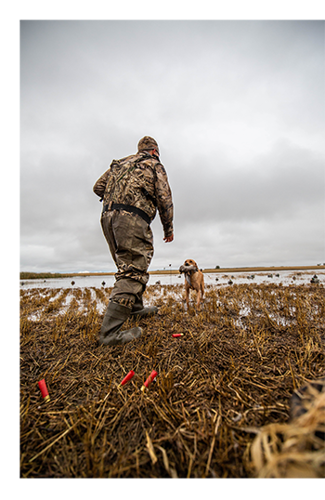
Plan out sheet-water hunts as much as possible. From a safe distance, identify the types of ducks using it, and note how they approach and spread out once they are on the water. Then, try to determine the best route to the spot. Sometimes, you might be able to walk across cut fields with decoys on your back. At other places, you’ll have to slog through flooded mud flats. Decoy carts and sleds are helpful in such scenarios.
Your setup depends on the sheet water itself. I’ve hunted flooded fields and pastures in the Dakotas where rock piles, hay bales, or grassy ditches provided sufficient concealment. If the cover is heavy enough, you might even get away with sitting on a stool or bucket.
If you’re hunting open fields, layout blinds are a good option. But brush them in beforehand to save time. Cover the blinds with natural materials, using hay or cut tall grasses to mimic the color of a harvested wheat or oat field. A layout chair paired with a brown or green ghillie blanket is another option. A-frame-style blinds can also work but take time to brush in and are more cumbersome.
Flooded fields and pastures are naturally wet, so using a conventional layout blind or sitting in an A-frame can get messy. Wearing waders or waterproof bibs and rubber knee boots can help. The plastic sled you use to haul the decoys can also double as a blind (and keep you dry). MoMarsh makes layout blinds that sit on telescoping legs that can keep you just above the water as well.
Setting the Rig
When hunting small pools of sheet water, it’s wise to back off so you’re not right on top of where ducks want to land. If possible, place your hides 20 to 30 yards from the decoys. Don’t sabotage yourself by setting blinds directly upwind of the landing hole. At the very least, angle them 20 or 30 degrees left or right. If cover is sparse or there’s a strong wind, consider setting blinds perpendicular to the water so ducks aren’t looking right at you on approach (this is important with A-frames). If there’s little wind at shooting time, set up with the sun at your back when possible.
If you’re hunting mallards, wood ducks, and teal on a quarter-acre patch of sheet water, a few floating decoys will suffice. When trying to fool large numbers of geese, mallards, and other puddle ducks on bigger waters, mix some full-body field goose decoys in around the edges and augment them with floaters in the water. Silhouettes are another great option to add depth to the spread as they are light and packable.
Spinning-wing decoys can boost success, particularly on new water, so it’s smart to pack a few as long as it’s legal to do so (some U.S. states and public areas don’t allow them). Models with remote controls are best so you can turn them off if geese approach.
Sheet-water often produces one or two good hunts before conditions change or the birds find an area with less pressure. Hunt as efficiently as possible, then leave the area quickly, allowing birds a chance to trickle back without being shot to minimize pressure. Consistent success is dependent on finding multiple locations. That requires work, but the search (and getting permission) is part of the payoff to hunting sheet water.
Article originally published in Delta Waterfowl's 2026 Hunt Annual magazine.
Join Delta Waterfowl to receive our member-exclusive magazine and eNewsletter—packed with the latest in duck research, expert tips on duck dogs, hunting insights, conservation updates, and more.
Your membership helps you stay informed while supporting the future of waterfowling. Join now: Become A Member.