
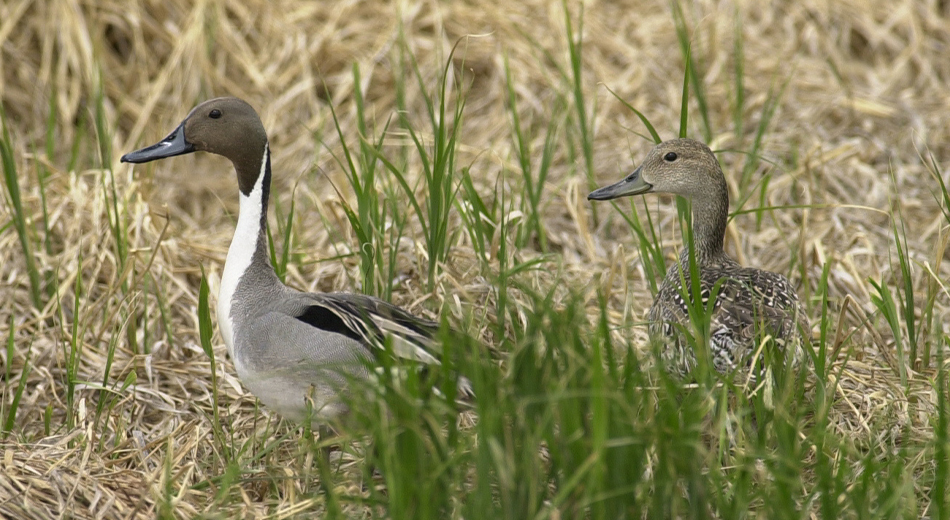
The Nomadic Northern Pintail
‘Sprigs’ chart a wandering path shaped by early migrations, perilous nest options, and a changing landscape
By Christy Sweigart
At half past seven, a splash broke the stillness of the murky pond where I sat concealed on the bank. My wirehaired dog hurried out through the fog and the mist and the mud, delivering the bird to hand with a rapid shake and a proud stride that seemed to say, “Hey! Did you see that?”
Though it was late December, I saw no sign of the pintail’s signature sprig. Later, I learned that he was likely a late molter; pintails begin growing those distinct tailfeathers around Thanksgiving, and it’s no quick task. Sprig or not, I had identified him the moment he coasted into the spread, gliding in with the effortless grace only a pintail carries.
While the northern pintail is admired for its speed and elegance, it follows a demanding path shaped by early migrations, broad movements, and distinct nesting habits. Understanding this annual journey begins with the season most critical to waterfowl populations: spring.
A Big Sprig World
When spring approaches the horizon, the northern pintail wastes no time. By March, they’re already winging their way north, chasing the promise of fresh wetlands just as the ice has begun to melt. But pintails can be picky when it comes to water conditions.
Pintails nest in several regions. In wet years, when the prairies are bursting with water, many pintails will settle in the prairie pothole region. In dry years, larger numbers may scout the prairies but keep moving north in search of more stable water sources in the boreal forests of Canada and Alaska, or even as far as the Arctic tundra.
“The variety of places that pintails nest is really incredible,” said Dr. Chris Nicolai, waterfowl scientist for The Duck Hunters Organization™. “Pintails have a lot more options than other prairie ducks because their distribution is so much more widespread. I’ve got bands in my office that were recovered here in the United States but came from Japan. Researchers have put radios on pintails and tracked them breeding in Russia — some come back, some stay over there. The scope of their world is much greater than species like the blue-winged teal that pretty much stick to nesting in the PPR.”
While their larger range gives pintails flexibility in nesting regions, they are met with ample challenges once they settle into their breeding grounds.
Sparse Cover, Steep Costs
When compared to other dabbling species, pintails are known for being “early” in both migration and nesting. While having a head start may provide them the first choice of wetlands and first opportunity to scout resources, it also creates risks.
“Pintails often lay their first nests by late April,” said Dr. Nicolai. “But their choice of nesting cover has been substantially impacted by the changes we’ve seen in agriculture, like no-till farming. This shift away from traditional discing toward continuous cropping has resulted in millions of acres of bare stubble, providing minimal concealment for nesting pintails. But pintail hens still attempt to nest in these exposed landscapes and are exposed to farm implements.”
Pintails are notorious for nesting in sparse cover such as stubbled cropland, rather than the thick vegetations most other waterfowl prefer. Unfortunately, that choice often leads them into what’s called an ecological trap — an area that appears suitable for nesting but is actually poor habitat that jeopardizes long-term survival.
“It looks like good nesting cover, but predators hit these nests hard,” said Dr. Nicolai. “Delta’s research also suggests that nest success for all ducks is lowest early in the breeding season. These predators are waking up after a long winter, and since pintails are early migrators and early nesters, they may be some of the only nests on the landscape.”
Pintails also tend to nest farther from water than most ducks, making it harder for hens and ducklings to escape predators. And if their nests survive predation, spring planting often destroys many of them during seeding.
This early timing, paired with changes in agriculture and the loss of wetlands in important breeding areas, has been known to create low rates of nest success — the biggest determinant of whether a duck population rises or falls.
Early Exit
If a pintail’s first nest fails, research has shown that the hen will attempt to renest.
“Though less persistent renesters than mallards, which may try four or five times in a breeding season, pintails generally renest once or twice before giving up,” said Dr. Nicolai. “They’re often one of the first species to depart the breeding grounds and head back south.”
Similar to their early arrival to the breeding grounds, these earlier-than-most migration patterns, though providing bountiful food resources and the first touch of many wetlands, also provide challenges.
“The same time of year that they are migrating is the peak of disease outbreaks,” said Dr. Nicolai. “For some of the areas that pintails frequent in the western states like Klamath National Wildlife Refuge or the Great Salt Lakes, botulism can run rampant between July and September. Pintails, because of their tendency to migrate early, become an unfortunate statistic in that equation.”
Despite these risks, pintails continue their annual journey to wintering strongholds across the continent, including the key regions of California’s Central Valley, the coasts of Oregon and Washington, the rice-growing regions of Texas, Arkansas, and Louisiana, the Gulf coast marshes of Texas and Louisiana, and further south to Mexico.
Made to Move
Long-term survey data helps track the patterns and pressures shaping northern pintail populations across North America. Although their populations have experienced a long-term decline since the Waterfowl Habitat and Breeding Population Surveys began in 1955, their numbers remain relatively strong. The most recent 2024 estimate places the continental population at just under 2 million birds, even as they continue to face pressure from a changing landscape.
So, if you’re reading this from a zip code that’s fortunate enough to be graced by pintails each hunting season, may this serve as your reminder: Pull that bead just a bit farther ahead—these ducks are hardwired to stay on the move.
Christy Sweigart is associate editor of Delta Waterfowl.
--
Article originally published in Delta Waterfowl's summer 2025 magazine.
Join Delta Waterfowl to receive our member-exclusive magazine and eNewsletter—packed with the latest in duck research, expert tips on duck dogs, hunting insights, conservation updates, and more.
Your membership helps you stay informed while supporting the future of waterfowling. Join now: Become A Member.